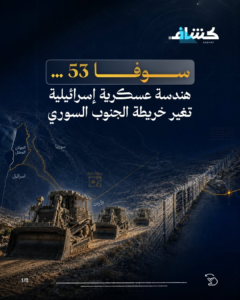
The buffer zone in southern Syria, governed by the 1974 Disengagement Agreement under the supervision of the United Nations Disengagement Observer Force (UNDOF), has witnessed accelerating Israeli engineering and military activity aimed at redrawing the region's geographic and security map. This activity is being carried out through a prominent military project known as "Sufa 53" or "The Great Storm," which involves incursions and the construction of military infrastructure inside Syrian territory.
The Nature of the Project and Its Targeted Geographic Scope
The "Sufa 53" project extends along the lines adjacent to the occupied Golan, targeting three main sectors in Quneitra Governorate:
- Northern Quneitra countryside: The engineering operations begin from the town of Hadar and reach Jubata al-Khashab.
- Villages of the central countryside: The activity includes the towns of al-Hamidiyah, al-Qahtaniyah, Ruwayhinah, Bir Ajam, and Bariqa.
- Southern Quneitra countryside: The works extend as far as the town of al-Asha and the Syrian-Jordanian-Israeli border triangle.
In these areas, Israeli military engineering relies on the use of heavy bulldozers and clearing equipment to build earthen berms, erect a reinforced barbed security fence, and cut new military roads that penetrate deep into the buffer zone.
The Timeline and the Evolving Pace of Work
The project has passed through different phases tied to field and political shifts inside Syria:
- The launch (mid-2022): Israeli military machinery began initial work clearing routes and establishing advanced observation points.
- The acceleration (late 2024): The pace of engineering operations rose markedly, accompanied by an expansion in the encroachment on land and the cutting of paved roads for the machinery.
- The current phase: The works have witnessed further acceleration, aimed at consolidating the incursion and entrenching the new geographic reality inside Syrian territory, exploiting current field conditions.
The Security Justifications and Motives
The military engineering machinery is operating on the basis of a security vision imposed by political transformations:
- The previous motives: Israeli plans focused on establishing a buffer zone secured technically and militarily against any potential threat from armed factions linked to Iran and its proxies in the region.
- The current motives: The Israeli strategy has been tied to apprehension and a lack of trust in the security arrangements associated with the new Syrian government, which has driven it to impose direct facts on the ground to protect its northern borders.
The Resulting Losses and Field Repercussions
The ongoing engineering operations have resulted in direct material and geographic damage on both sides of the border, represented in:
- Destruction of the local environment: Near-total destruction of vegetation cover and natural pastures as a result of soil bulldozing and the building of berms.
- Encroachment on agricultural land: The seizure of thousands of dunams of fertile agricultural land that had been a primary source for the local population's economy.
- Restriction of movement: Preventing Syrian residents and farmers from reaching their land located behind or alongside the new incursion, isolating entire villages from their natural extension.
The Legal and Political Dimensions of the Project
The "Sufa 53" project represents a blatant field violation and an undermining breach of the Disengagement Agreement signed in 1974, given that Israeli military machinery has penetrated hundreds of meters deep into the separation zone (the buffer zone) and seized new land that does not fall under its legal sovereignty. These movements place the international community and UNDOF before a new geographic reality that pulls the region out of the context of defensive de-escalation and into the context of imposing geographic borders by military force.